
What is a sub-to (subject-to) deal in real estate?
How sub-to deals work, why investors want them, why sellers agree, and how to find owners who fit.
A sub-to deal, short for "subject-to the existing mortgage," is a way to buy a house without getting a new loan. The seller signs the deed over to the buyer, the seller's mortgage stays in place, and the buyer takes over the monthly payments.
Investors want these deals because they can keep the seller's low interest rate and buy with far less cash than a bank loan needs. This guide explains how sub-to works, who uses it and why, why sellers agree, and how to find owners who fit. We'll show the search in The Invest Nest, real estate investing software to find, track, and close off-market deals.
How does a sub-to deal work?
In a regular sale, the buyer gets a new loan, and the seller's loan is paid off at closing. In a sub-to deal, the old loan stays in place, and the buyer takes over the payments.
Here's what happens at closing:
- The seller signs the deed over to the buyer, so the buyer owns the house.
- The seller's mortgage stays in the seller's name.
- The buyer makes the monthly payment from then on.
- The buyer doesn't apply for a loan, so the bank doesn't approve them or check their credit.
Most investors call it "sub-to." You'll hear it in conversations about creative finance, along with seller financing and lease options.
Why do investors want sub-to deals?
They keep a low interest rate. Many homeowners locked in rates near 3% in 2020 and 2021. The average 30-year rate today is about 7.2% (Freddie Mac, October 29, 2026). A buyer can't get the old rate from a bank, but with sub-to, the old loan comes with the house.
Here's what that means on a house worth $205,000, where the owner still owes $195,000 on a 3% loan from 2021:
| Compared | Sub-to | A new bank loan at 7.2% |
|---|---|---|
| Down payment | None to a bank | About $41,000 (20%) |
| Loan | The seller's loan, $195,000 left at 3% | $164,000 at 7.2% |
| Monthly principal and interest | About $915, the seller's existing payment | About $1,115 |
Taxes and insurance come on top of either payment.
They need far less cash. There's no down payment to a bank. The cash usually covers closing costs, catching up any missed payments, any money the seller needs to move on, and repairs. Experienced investors add all of that up before they look at the price. Many deals still take a few thousand to a few tens of thousands of dollars, so "no money down" is rarely the real story.
They don't need to qualify for a loan. A buyer without the credit or income history for a bank loan can still buy, and so can an investor who already has as many loans as banks will give them.
They can close fast. With no lender underwriting, a sub-to deal can close as quickly as the title company can do its work.
Who uses sub-to deals?
- Rental investors keep the house as a rental. With a low payment, the rent can cover the mortgage, taxes, insurance and repairs with money left over.
- Flippers skip the hard-money loan. They hold the house on the seller's low payment while they fix it up, and the sale pays off the seller's loan.
- BRRRR investors buy, fix up and rent the house, then refinance into their own name. They give up the low rate, but they pull out the equity the repairs created and take the loan off the seller's credit.
- Wholesalers find the seller, put the deal under contract and assign it to another investor for a fee. Many sub-to deals are put together this way, often for buyers who don't have a large down payment or can't get a bank loan.
- Newer investors use sub-to to buy a first rental they couldn't finance the regular way.
Why would a seller agree to a sub-to deal?
Most sub-to sellers are in a hard spot. They may be behind on payments, moving for a job, going through a divorce, dealing with an inherited house, or tired of managing a rental. Their biggest worry is often a foreclosure on their credit.
Many of them also have little or no real equity. Take an owner whose house is worth $205,000 who owes $195,000 and is a couple of payments behind. On paper, that looks like $10,000 of equity. But after about 6% in agent fees and 2% in closing costs, selling would cost about $16,400. The owner would have to bring about $6,400 to closing, plus the missed payments, just to sell. A cash offer below the loan balance doesn't work for them either.
A sub-to deal gives that owner a way out:
- They can move on without bringing money to closing.
- The buyer catches up the missed payments and makes every payment from then on.
- They don't pay agent fees or make repairs.
- They may get a little cash to help them move.
The loan does stay in the seller's name, so the seller is trusting the buyer to pay. Good investors earn that trust in writing: the contract says the buyer pays the loan and insures the house, and a loan servicing company makes each payment so the seller can see it.
How is sub-to different from other ways to buy?
| Way to buy | Who owns it | The loan | Bank approval |
|---|---|---|---|
| Sub-to | The buyer | The seller's loan stays in place | No |
| Loan assumption | The buyer | Moves into the buyer's name | Yes |
| Seller financing | The buyer | The seller acts as the bank | No |
| Lease option | The seller, until the option is used | Unchanged | No |
Sub-to fits an owner with a loan and little equity. Seller financing fits an owner whose house is paid off. When an owner has some equity, investors sometimes combine the two: they take over the loan and pay the seller their equity over time.
Which owners fit a sub-to deal?
Look for owners with:
- A mortgage on the house. With no loan, there's nothing to take over.
- A low interest rate. Loans from 2020 to early 2022 usually carry the lowest rates.
- Little equity. That's why a regular sale or a cash offer doesn't work for them. An owner with a lot of equity usually wants cash instead.
- A reason to sell soon. Behind on payments, moving, vacant, inherited, or a listing that didn't sell.
| The owner | Why a sub-to offer can work for them |
|---|---|
| Behind on payments | They want to stop a foreclosure before it hits their credit |
| Cancelled listing | The house didn't sell, often because the price had to cover the loan and the fees. A sub-to offer can cover what they owe |
| Tired landlord | They want out of the rental and don't need a large check |
| Out-of-state owner | They live far away and want the house off their plate |
| Vacant house | They're paying a mortgage on a house nobody lives in |
| Inherited house | The heirs don't want the house or its payment |
How do you find sub-to deals?
You find sub-to sellers the same way you find any off-market deal, with one change. A cash buyer looks for high equity. A sub-to buyer looks for owners with a mortgage and little equity. Here's how to run that search with The Invest Nest:
- Search your market. Enter a city, county, or zip code.
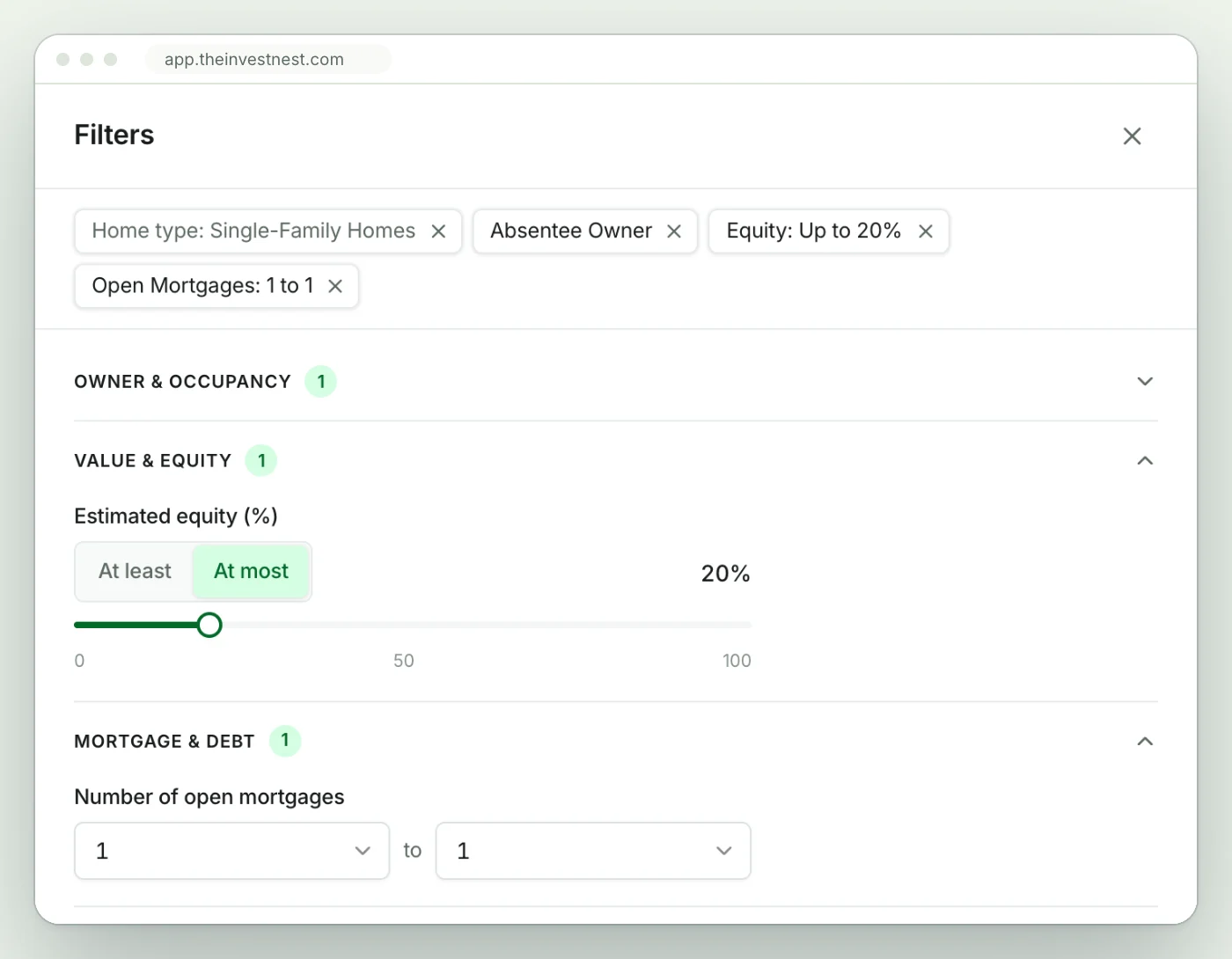
- Apply a motivated seller filter. Start with one from Nest Leads, such as Pre-Foreclosure, MLS Cancelled, Absentee Owner, Out Of State Owner, Vacant, or Inherited.
- Refine by equity. Open All filters, go to Value & equity, and set Estimated equity (%) to 20% or less.
- Refine by mortgage. Under Mortgage & debt, set Number of open mortgages to 1. One loan keeps the deal simple.
- Save the results to a list. Run the search with other motivated seller filters, save those lists too, and stack them into one list to work.
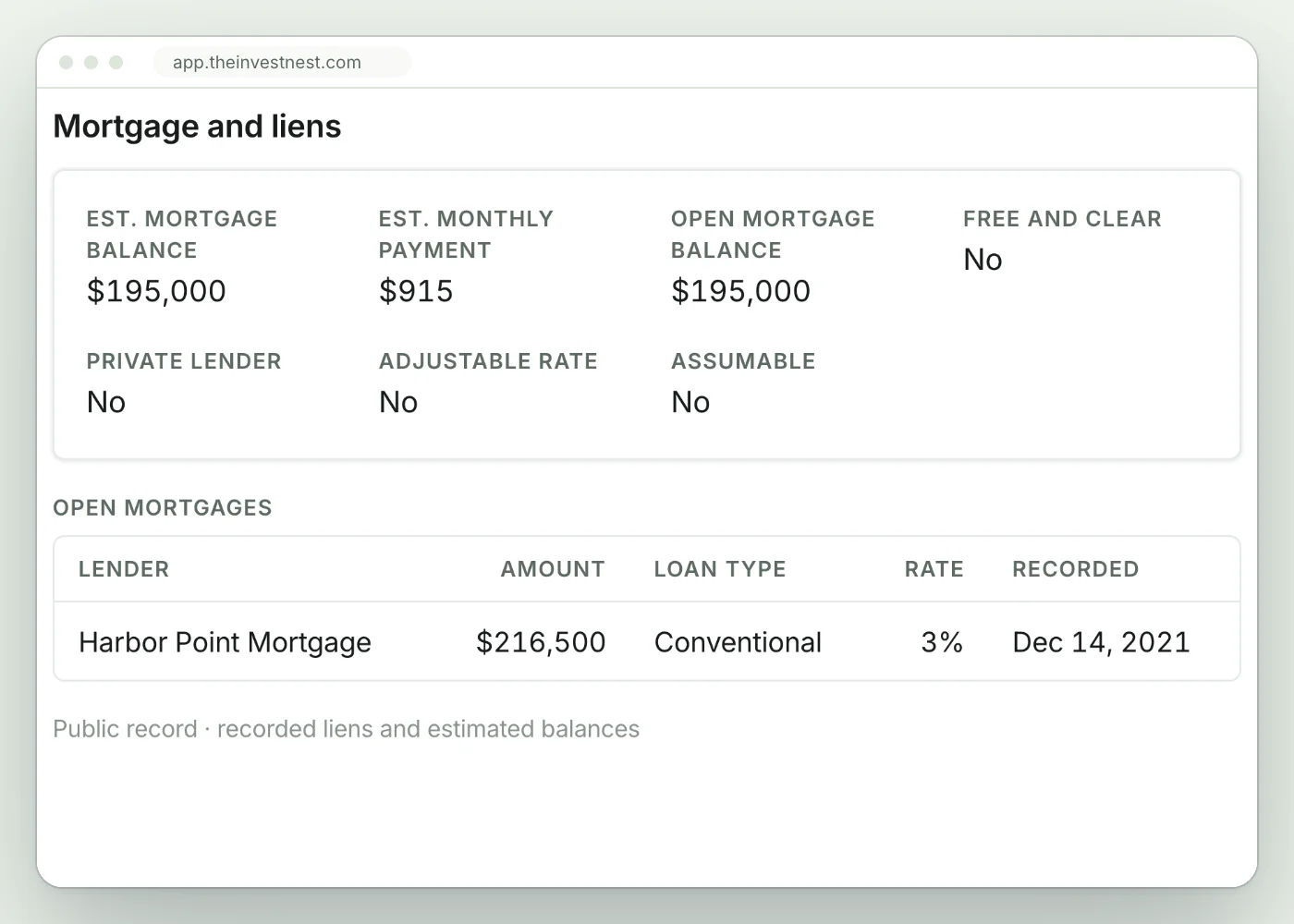
- Check the loan. Open a property. The Mortgage and liens section shows the lender, the loan amount, the loan type, the rate when the record has it, the recorded date and the estimated balance. These are public records and estimates, so confirm them with the owner.
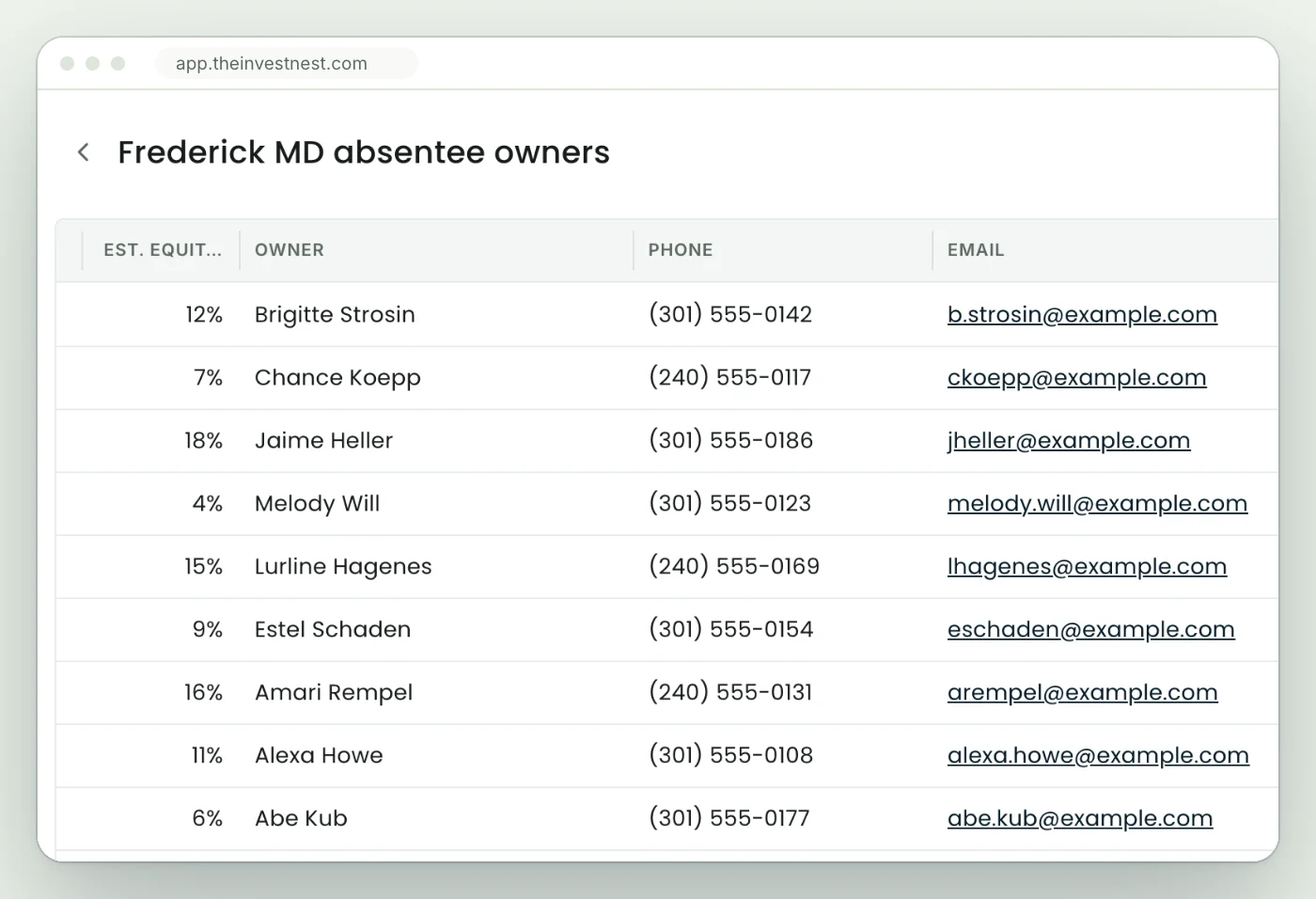
- Skip trace the owners. A skip trace looks up an owner's phone numbers and emails. Do one property, or select several or all of the properties in your list and skip trace them at once. Each owner's phone numbers, emails and mailing address show up in your list, plus any other properties they own.
- Reach out and make an offer. Call or text the owner and start with their situation, not with sub-to. Ask what they owe, whether they're current on payments, and when they need to move. Their answers tell you whether a sub-to offer can help them.
Track every lead in your drag-and-drop deal pipeline, with stages named the way you work.
How do you work a sub-to deal?
- Get the loan details. Ask the seller for a recent mortgage statement: the balance, the rate, the payment and the escrow for taxes and insurance.
- Run the numbers. Add up all the cash the deal takes, then compare the full monthly payment with what the house will rent or sell for.
- Put it in writing. Have a real estate attorney draft or review the contract.
- Close with a title company. They check for other liens, record the new deed, and handle the closing.
- Set up the payments. Many investors use a loan servicing company, so the lender is paid on time and both sides can see each payment.
- Set up the insurance. Work with an insurance agent who knows sub-to deals, so the house is covered and the lender stays on the policy.
What are the risks?
- The lender can call the loan due. Most mortgages have a due-on-sale clause that lets the lender ask for the full balance when the house changes hands. Keep money set aside, and have a plan to refinance or sell if it happens.
- The seller's credit depends on the buyer's payments. A late payment hurts the seller, so pay on time and let them see it.
- The rules differ by loan and by state. Some states also have rules for buying from owners in foreclosure. Ask your attorney or title company before you close.
This guide is general education, not legal advice.
What does it cost to find these deals?
The Invest Nest is one plan at $65 a month, with a free 7 day trial. It includes over 150 million properties, 21+ Nest Leads and over 100 additional filters, 500 skip traces every month, and your drag-and-drop deal pipeline.