
How to find motivated sellers in your market
Learn why some homeowners need to sell quickly, how real estate investors find them, and how to tell which owners are ready to sell.
A motivated seller is a property owner who has a reason to sell their house quickly. Usually they have a problem that a fast sale would solve. They may have fallen behind on the mortgage and be close to losing the house. They may have inherited a house in another state that they don't want to look after. Or they may own a rental that sits empty and costs them money every month.
Many of these owners can't sell the normal way, or don't want to. Selling a house through an agent usually takes three months or more, and the owner often has to pay for repairs first. An owner who is facing a foreclosure date, or who can't afford the repairs, may not have that long.
That is why real estate investors look for these owners. An investor can buy the house as it is and close quickly, so the owner's problem is solved. This guide explains the situations that make an owner motivated, how investors find those owners in their market, and how to reach them. We'll show how to do each step with The Invest Nest, real estate investing software to find, track, and close off-market deals. An off-market deal is the sale of a house that was never listed for sale.
What is a motivated seller?
A motivated seller is an owner who needs or wants to sell their house sooner than they planned. Something in their life has changed, and the house has become a problem they need to solve.
Most of the time the change is a hard one. The owner may have lost a job and fallen behind on the payments. A parent may have died and left them a house. They may be going through a divorce, or moving for work, or worn out from years of managing a rental. Sometimes the change is a good one. An owner who paid off the house years ago may want to move somewhere smaller, without the work of fixing the house up and listing it.
What these owners have in common is that something matters more to them than getting the highest price. They want the sale to be fast, they want to be sure it will happen, or they don't want to fix the house up first.
A house in bad shape doesn't always mean a motivated seller. A run-down house can belong to an owner who pays every bill on time and has no plans to sell. A well-kept house can have a foreclosure notice filed against it. That is why investors pay attention to the owner's situation, and not only to how the house looks.
Why would an owner sell without listing the house?
Most people sell a house by listing it with an agent, because a listed house usually sells for the highest price. So why would an owner sell to an investor for less? There are usually three reasons, and many motivated sellers have more than one of them.
The owner's situation makes the house a burden. Here are the situations investors see most often:
- The owner is behind on the mortgage. After several missed payments, the lender starts the foreclosure process. If the owner does nothing, the house is sold at an auction. The owner loses the house and has a foreclosure on their credit report. They also risk losing much of their equity. Equity is the part of the house's value that belongs to the owner after the loan is paid off. If they sell before the auction, they can pay off the loan and keep what is left.
- The owner inherited the house. The new owner often lives far away and already has a home. The house may still be full of a relative's belongings, and several family members may be waiting to split the money.
- The owner has a rental that sits empty. A vacant rental earns nothing, but the owner still pays the taxes, the insurance and the upkeep every month.
- The owner is tired of being a landlord. After years of repairs, late rent and finding new tenants, some landlords want to stop, especially if they manage the rental on their own.
- The house needs work the owner can't pay for. A house in poor condition is hard to sell on the market, because a buyer's lender can require repairs before it approves the loan.
The owner doesn't have time for a normal sale. A listed sale has many steps. The owner finds an agent, gets the house ready, has it photographed and lists it. Then they wait for a buyer. After they accept an offer, they usually wait another five to six weeks for the buyer's inspection, appraisal and loan approval. From deciding to sell to closing, it often takes three months or more. An owner with a foreclosure auction a few weeks away doesn't have three months.
The owner wants to be sure the sale will happen. A listed sale can fall apart late. The buyer's loan can be denied, the inspection can find problems, or the appraisal can come in low. Then the owner has to start again. An investor who buys the house as it is, on a set date, takes away that risk.
A sale to an investor solves these problems. The owner doesn't make repairs, doesn't show the house, and knows the date the sale will close. Many owners accept a lower price for that.
Why do investors look for motivated sellers?
Investors look for motivated sellers because these are the owners who are open to an offer below the full market price. The lower price is what leaves room for the investor to pay for repairs and still make a profit, whether they plan to resell the house, rent it out, or pass the deal to another investor.
There is a second reason. A house that isn't listed isn't shown to every buyer in the market, so the investor isn't bidding against families shopping for a home. Other investors may be calling the same owner, though. The investor who stays in touch is usually the one who gets the deal.
Some motivated sellers care less about the price than about getting out from under the monthly payments. In a sub-to deal, for example, the buyer takes over the seller's mortgage payments.
Good investors treat a deal as solving the owner's problem, and they don't try to take advantage of it. They start by asking what the owner needs, and then they make an offer that works for both sides.
What are the signs of a motivated seller?
An investor can't know what is happening in an owner's life. But many of these situations leave a record. A lender files a notice when it starts a foreclosure. A county records unpaid property taxes. A deed shows when a house passes to a family member. Investors search for these records to find owners who may want to sell.
Here are the most common signs, why each one matters, and the filter that finds it with The Invest Nest.
| The sign | Why the owner may want to sell | The filter with The Invest Nest |
|---|---|---|
| The owner is behind on the mortgage | The lender has filed a pre-foreclosure notice. If the owner sells before the auction, they avoid a foreclosure and keep the equity that is left. | Pre-Foreclosure |
| The owner is behind on property taxes | Unpaid property taxes can end with the county selling the house, and they often mean the owner is short on money. | Tax delinquent year, in All filters |
| The owner inherited the house | The new owner often lives far away, has no use for the house, and may need to split the money with family. | Inherited, and Pre-Probate when the owner on the deed has recently died |
| The house is vacant | The owner pays taxes, insurance and upkeep on a house that earns nothing. | Vacant |
| The owner lives somewhere else | Every repair and every tenant problem has to be handled from a distance. | Absentee Owner, Out Of State Owner |
| The owner is a tired landlord | A small landlord who has owned a rental for many years may be worn out by tenants and repairs. | Absentee Owner with Years owned |
| The owner pulled their listing | The owner already tried to sell the house, then took it off the market without selling it. | MLS Cancelled |
| The owner has a lot of equity | An owner who has paid off most or all of the loan can accept a lower price and may be ready to sell. | High Equity, Free And Clear |
| There is a court judgment against the owner | A judgment is a debt the owner has been ordered to pay, and it usually has to be paid when the house is sold. | Judgment |
A pre-foreclosure notice is one of the strongest signs. Federal rules generally stop a lender from starting a foreclosure until the loan is more than 120 days behind. So an owner with a notice on record has usually missed at least four months of payments.
Owners with a lot of equity are different. They rarely have to sell. Treat them as a list that you stay in touch with over many months.
Keep one thing in mind with every sign. A record shows that an owner might have a reason to sell. It doesn't show that they want to sell, or that they want to sell to you. You only find that out by talking to them.
Where do motivated seller leads come from?
A lead is an owner who might sell. Investors find leads in several ways. Some send mail or run ads so that owners call them. Some get referrals from real estate agents and attorneys. These four ways start with the investor finding the owner:
- County records. Pre-foreclosure notices, tax records and probate filings are public. You can look them up yourself for free. It is slow, and every county keeps its records in a different way.
- Driving for dollars. This means driving through neighborhoods and looking for houses that seem empty or neglected. The signs are an overgrown yard, boarded windows, a damaged roof or gutters, piled-up mail, or notices posted on the door. A neglected house often means the owner has moved away or can't keep up with it. Investors write down each address. Then you can upload your own list of property addresses to The Invest Nest and skip trace the owners. A skip trace finds an owner's phone numbers and email addresses.
- Bought leads. Some companies sell leads one at a time. It is fast, but the same owner may be sold to several investors.
- A list from property data. Real estate investing software lets you search a whole market for owners who show the signs above, and save them to a list. Many investors start here, and the rest of this guide shows how.
How do you build a motivated seller list in your market?
Here is how to build a list with The Invest Nest:
- Search your market. Enter a city, a county, or a ZIP code.
- Apply Nest Leads. Nest Leads are our motivated seller indicators, and they sit right under the search box. Examples are Pre-Foreclosure, Vacant, Absentee Owner, Inherited and High Equity. Each one points to a reason an owner might want to sell. You can apply one, or several at once.
- Refine your results with filters. Open All filters for over 100 additional filters. Examples are Years owned, Estimated equity, Owner type, Tax delinquent year, and the date of the pre-foreclosure notice.
- Save the results to a list. Select the properties you want, or select all, and save them to a new list or to a list you already have.

You can watch the whole search in our tutorial, How to stack motivated seller filters.
What is list stacking, and why does it work?
List stacking means searching for owners who show more than one sign. One sign alone doesn't tell you much. An owner who lives in another state may be perfectly happy with their rental. But if that owner's house is also vacant, and the property taxes are unpaid, there are three reasons they might want to sell. That owner is a much better person to call.
With The Invest Nest, you can stack in two ways:
- In one search. Apply several Nest Leads and filters at once. Every result matches all of them.
- Across lists. Save a list for each kind of owner. Then select the owners you want to call first and add them to one list.
Each sign you add makes the list shorter. That is the goal. You want fewer owners, each with stronger reasons to sell. Stop adding signs before the list becomes too small to be useful.
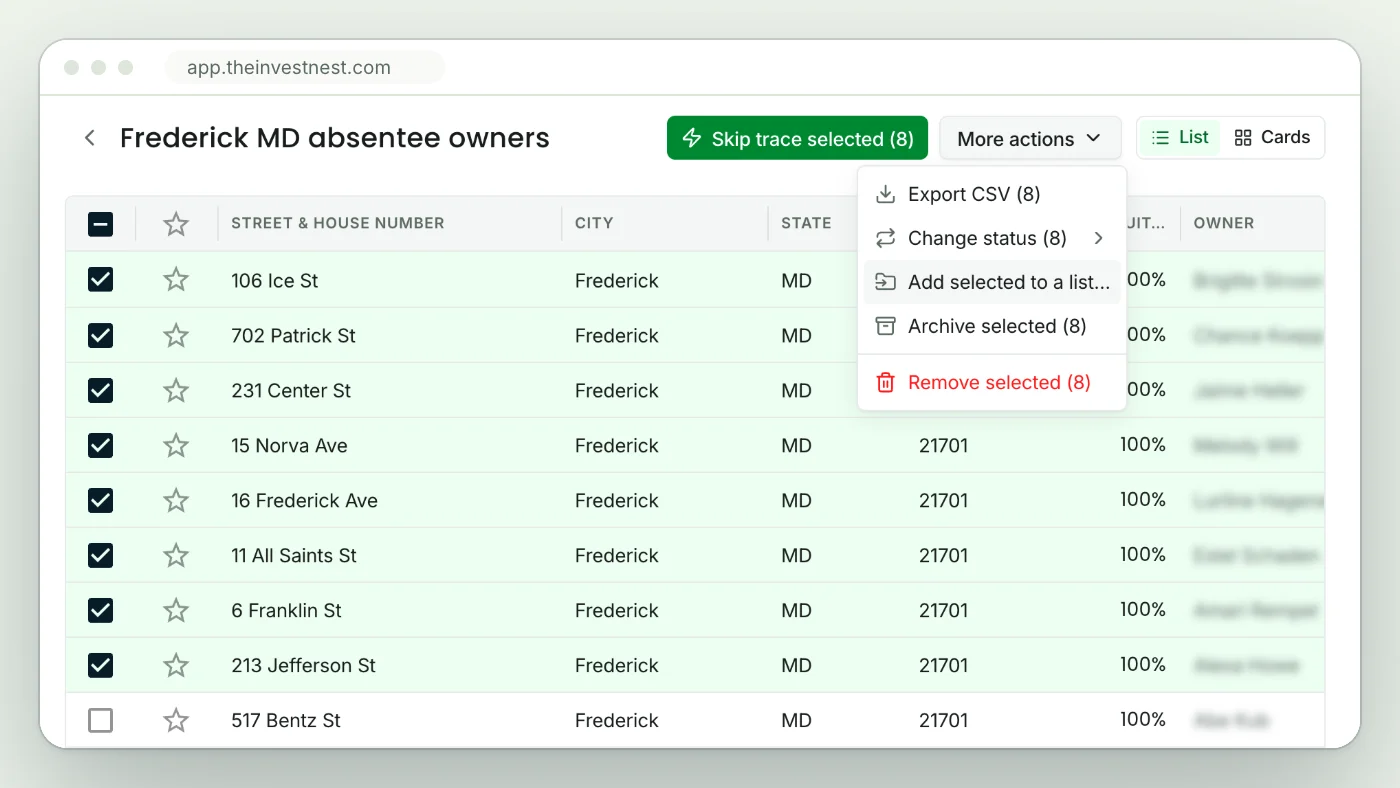
Here are four lists to start with.
A tired landlord list
Apply Absentee Owner, which finds owners who don't live in the house. In All filters, set Years owned to 10 or more, and set Owner type to Individual. Individual means a person owns the house, and not a company like an LLC. A person who owns a rental in their own name is often the one dealing with the tenants, and is easier to reach by phone than a company. You can add High Equity to find owners who can accept a lower price. Tired landlords rarely sell on a schedule, so plan to follow up for months.
A vacant property list
Apply Vacant. Then add Out Of State Owner, or set a Tax delinquent year in All filters. An owner who pays for an empty house from another state, or who has stopped paying the property taxes on it, has a strong reason to sell.
An inherited property list
Apply Inherited or Pre-Probate, then add Out Of State Owner. A person who inherits a house far from where they live often doesn't want to manage it. Be gentle with these owners, because they may be grieving.
A pre-foreclosure list with equity
Apply Pre-Foreclosure and High Equity. These owners have a deadline, and they have enough equity to sell the house and pay off the loan before the auction. In All filters, set the pre-foreclosure notice date to the last few months, so you reach the newest notices first. Many states have special rules for buying a house from an owner in foreclosure. Learn the rules in your state before you make an offer. Our guide on how to find pre-foreclosure properties explains more.
How do you reach a motivated seller?
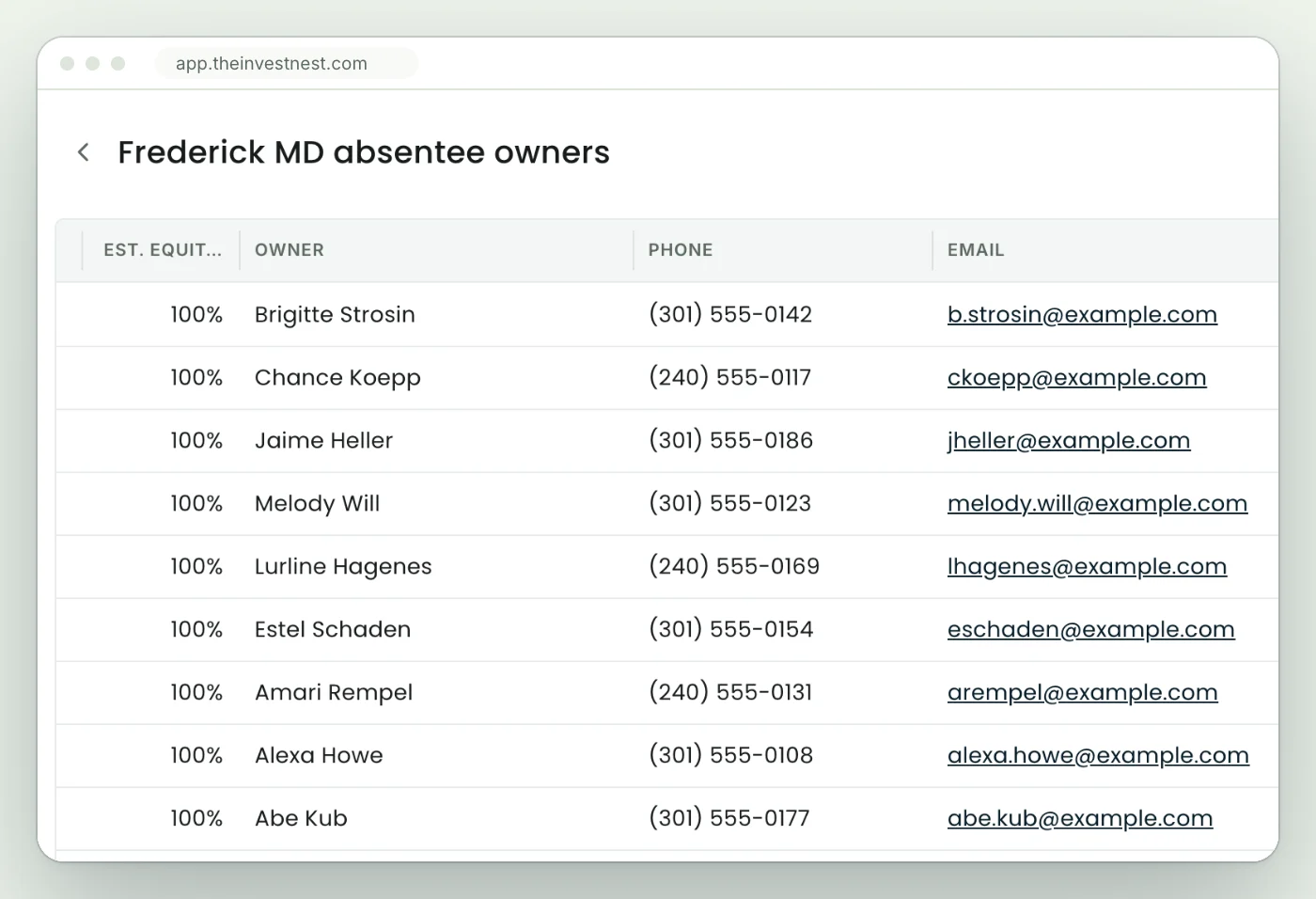
A list shows you the properties. To reach an owner, you need their name, their mailing address and their phone numbers, and a skip trace finds them. Some investors send a letter first, and others call.
With The Invest Nest, select a few properties in your list, or select all, and bulk skip trace them. Each owner's phone numbers, emails and mailing address show up in your list, plus any other properties they own. Every number has a phone quality score, with a do-not-call flag where one applies, so you know which number to call first. The plan includes 500 skip traces every month. Our skip tracing guide explains how skip tracing works.
There are rules for calling and texting owners. Before you call or text, check the National Do Not Call Registry and your state's rules on calling and texting people who haven't asked to hear from you. Sending text messages in bulk has strict rules of its own. This guide is general education, and it is not legal advice.
How do you qualify a motivated seller?
To qualify a seller means to find out whether they are ready to sell and whether a deal is possible. Before you call, open the property and look at what you are working with. You can see the owner, the estimated value and equity, the mortgage and any liens, and the sale history.
When you call, start by asking how the owner is doing and what they need. Don't start with an offer. Then find out four things. Most experienced investors ask these questions:
- Condition. What shape is the house in, and what repairs does it need?
- Timeline. If the price worked for them, when would they want to sell?
- Motivation. Why are they thinking about selling?
- Price. What price would they need to get for the house?
The more of these answers that point toward a sale, the better the lead. You don't have to make an offer on the first call. Learn the owner's situation, work out your numbers, and call back with an offer that solves their problem.
Most deals come from following up. An owner who says "not now" today may say yes in three months, when their deadline is closer. Keep track of every owner you talk to. With The Invest Nest's drag-and-drop deal pipeline, you can set a status for each lead and leave a note after every call, so you know who to call back and when.
Where should you start?
Start with one market and one list. Here is an example. Search the city you want to buy in. Apply Vacant and Out Of State Owner, and save the results to a list. Skip trace the list. Check the phone numbers against the do-not-call rules, then call the owners. Ask the four questions, and write a note after each call. Call back the owners who weren't ready.
One small list that you work all the way through will teach you more than five big lists you never finish.
How much does it cost to find motivated sellers?
Finding motivated sellers by hand costs more time than money. You drive through neighborhoods and look up county records yourself. Software costs money and saves you that time.
The Invest Nest is one plan at $65 a month, with a free 7 day trial. It includes over 150 million properties, 21+ Nest Leads and over 100 additional filters, 500 skip traces every month, and a drag-and-drop deal pipeline.