
How to find off-market properties
Real estate investors look for off-market properties, which are houses that aren't listed for sale, to find owners who need to sell quickly, such as an owner facing foreclosure. Here is how investors find these owners, reach them and make an offer.
An off-market property is a house that isn't listed for sale. When most owners want to sell, they hire a real estate agent, who lists the house for sale on the MLS, short for multiple listing service, so every agent and buyer in the area can see it and make an offer. That is what it means for a house to be on the market. An off-market property hasn't been put up for sale that way, so the only way to buy it is to find the owner and ask whether they want to sell.
Real estate investors look for off-market properties because that is where they find an owner who has to sell quickly and will take less than a listed sale might bring to get it done. That owner might be behind on the mortgage and facing foreclosure, might be about to lose the house over unpaid property taxes, or might be a family in another state that has to sell an inherited house to settle the estate. Investors find these owners by searching property data and county records for signs that an owner might want to sell, and by driving through neighborhoods for houses that look empty. We'll show how to do each step with The Invest Nest, real estate investing software to find, track and close off-market deals.
What are off-market properties?
Off-market properties are houses that aren't listed for sale, so no agent is showing them and there is no asking price. For a real estate investor, off-market properties come in three kinds.
- Houses that were never listed. The owner hasn't called an agent and may never call one. This is most of what investors mean by off-market properties.
- Listings that came off the market without selling. A listing can expire, or the owner can cancel it. The owner already wanted to sell, and the listed sale didn't work out.
- Houses sold privately. An agent can sell a house inside their own office, which is sometimes called a pocket listing.
There is no public list of off-market properties, which is why investors build their own from public records and property data, and reach the owners before the owners ever call an agent.
Why do owners sell off market?
Most owners sell by listing the house with an agent, because a listed house usually sells for the most money. But listing a house works best for an owner who has time, a house in good shape, and the money to pay for repairs. Some owners are missing one of those, and those are the owners investors look for.
An owner facing foreclosure. When an owner falls behind on the mortgage, the lender files a notice that starts the foreclosure, and the house is in pre-foreclosure until the foreclosure sale. If the owner sells the house before then, the owner pays off the loan, keeps whatever money is left and avoids a foreclosure on their credit. If the house goes to the foreclosure sale, the owner loses it and can walk away with little or nothing. In the fall of 2026, a typical listed home took about seven weeks to get an accepted offer (Redfin), and the buyer's loan then took about five more weeks to close (ICE, a mortgage data company), which can be more time than the owner has left. Pre-foreclosure is the situation investors look for most, and our pre-foreclosure guide explains it step by step.
An owner behind on property taxes. An owner who stays behind on the property taxes long enough can lose the house at a tax sale. Selling the house first lets the owner pay what they owe and keep the rest.
A family that inherited a house. When an owner dies, the family often has to sell the house to pay the estate's bills and divide the money among the heirs, and until the house is sold, the estate can't be closed. If the heirs live in another state and the house is full of a relative's belongings or needs work, fixing it up and listing it from far away can keep the estate open for months.
A house that needs major repairs. Most buyers pay with a loan, and a lender may not lend on a house with a failing roof or foundation. An owner who can't pay for those repairs can still sell the house as it is to an investor who pays cash.
In each case, selling the house as it is, straight to an investor who can close on a set date, solves the owner's problem. Investors call an owner like this a motivated seller, which is a property owner who has a reason to sell their house quickly. Several of these situations show up in public records, and our motivated sellers guide explains which record goes with each one.
Why do investors look for off-market deals?
Investors make their money by buying a house for less than it's worth, and that is hard to do with a listed house. A listed house is priced by an agent and shown to every buyer in the area, so it usually sells close to its full market value. An owner who needs to sell quickly is often willing to take less if the investor buys the house as it is and closes on a date the owner can count on. The owner gets a quick sale and money in the bank, and the investor has room to cover the repairs and still make a profit.
House flippers, landlords who rent houses out, and wholesalers, who put a house under contract and sell the contract to another buyer for a fee, all look for these deals. Because the house isn't listed, the investor talks with the owner directly and can learn what the owner needs before making an offer.
So the first thing an investor sizes up is the owner's situation. The owners worth calling have a reason to sell and equity in the house. Equity is the part of the house's value that belongs to the owner after the loan is paid off, and it is what lets an owner accept a lower price and still walk away with money.
Here is an example in round numbers. Say an owner has fallen behind on the mortgage, and the foreclosure sale is about six weeks away. Fixed up, the house would sell for about $250,000, but it needs about $25,000 of work the owner can't pay for. The owner owes about $110,000, including the missed payments and fees.
| Sold to an investor before the foreclosure sale | Lost at the foreclosure sale | |
|---|---|---|
| The sale price | About $150,000, and the investor covers the closing costs | Whatever the highest bid at the auction is |
| Repairs | None, because the investor buys the house as it is | None |
| When it's done | Closes in two to four weeks, on a set date | On the sale date, about six weeks away |
| The loan | Paid off at closing | Paid from what the house brings at auction |
| The owner's credit | A sale, not a foreclosure | A foreclosure, which stays on a credit report for seven years |
| What the owner walks away with | About $40,000 in cash, after the $110,000 is paid off | Whatever is left after the auction, which can be little or nothing |
The investor's price of about $150,000 comes from a rule many house flippers use, called the 70% rule. Under the 70% rule, an investor pays no more than 70% of what the house will be worth after repairs, minus the cost of the repairs. The investor still pays for the repairs, for holding the house and for selling it, so the investor's profit is much smaller than the gap between the price and the house's value after repairs.
Listing the house with an agent could bring the owner more, but only if the sale closed before the foreclosure date. A typical listed sale took about 12 weeks to close in the fall of 2026, and this owner has six.
What are the ways to find off-market properties?
Investors find off-market properties in five main ways.
| The way | How it works | What it costs | Owners you can reach | Who else knows about it |
|---|---|---|---|---|
| Searching property data | Software puts the county and property records for your whole area in one place, so you can search every property at once for owners who show signs they may want to sell. | $65 a month with The Invest Nest | Owners across your whole city, county or ZIP code | Other investors can pull a similar list, so looking for owners who show more than one sign, and following up, sets you apart. |
| Driving for dollars | You drive through neighborhoods and write down the addresses of houses that look empty or neglected. | Your time and your gas | The houses you can drive past in an afternoon | Other investors may drive the same streets. |
| County records | You search the county's public records, such as unpaid property taxes, probate filings after an owner dies, and pre-foreclosure notices, which a lender files when it starts a foreclosure. | Free to search, but slow | As many as you have time to pull, one county at a time | Anyone can look up the same records. |
| Deals other people bring you | A wholesaler or an agent offers you a house they found first. A wholesaler is an investor who puts a house under contract and sells the contract to another buyer for a fee. | A higher price or a fee | Only the deals they send you | Every buyer they send the deal to |
| Referrals | Attorneys, property managers and other investors tell you about owners who want to sell. | Your time and the relationships you build | Only the owners people tell you about | Whoever else they tell |
Driving for dollars gives you addresses, and county records give you addresses and owner names, but neither gives you phone numbers. Step 6 below shows how to upload those addresses and skip trace the owners.
How do you find off-market properties with The Invest Nest?
Of those ways, searching property data is the only one that lets you look at every property in your area at once, instead of one street or one county office at a time. Here is how to build a list of the owners of off-market properties with The Invest Nest.
- Search your market. Enter a city, a county, a ZIP code, or an APN, which is the parcel number the county gives each property. The off-market property search covers over 150 million properties, both listed and unlisted.
- Apply Nest Leads. Nest Leads are our motivated seller indicators, and they sit right under the search box. Each one points to a reason an owner might want to sell. Good ones to start with for off-market properties are Vacant, Absentee Owner, Out Of State Owner, Inherited and MLS Cancelled. Absentee Owner finds owners who don't live in the house, and MLS Cancelled finds houses that were listed for sale and had the listing cancelled, so the owner already wanted to sell. High Equity and Free And Clear, which means the house has no mortgage, find owners with the equity to accept a lower price. You can apply one Nest Lead, or several at once.

- Refine your results with filters. Open "All filters" for over 100 additional filters. For example, Owner type shows whether a person or a company owns the house, Tax delinquent year finds owners who are behind on their property taxes, and Listing status shows whether a house is listed, pending, sold or cancelled.
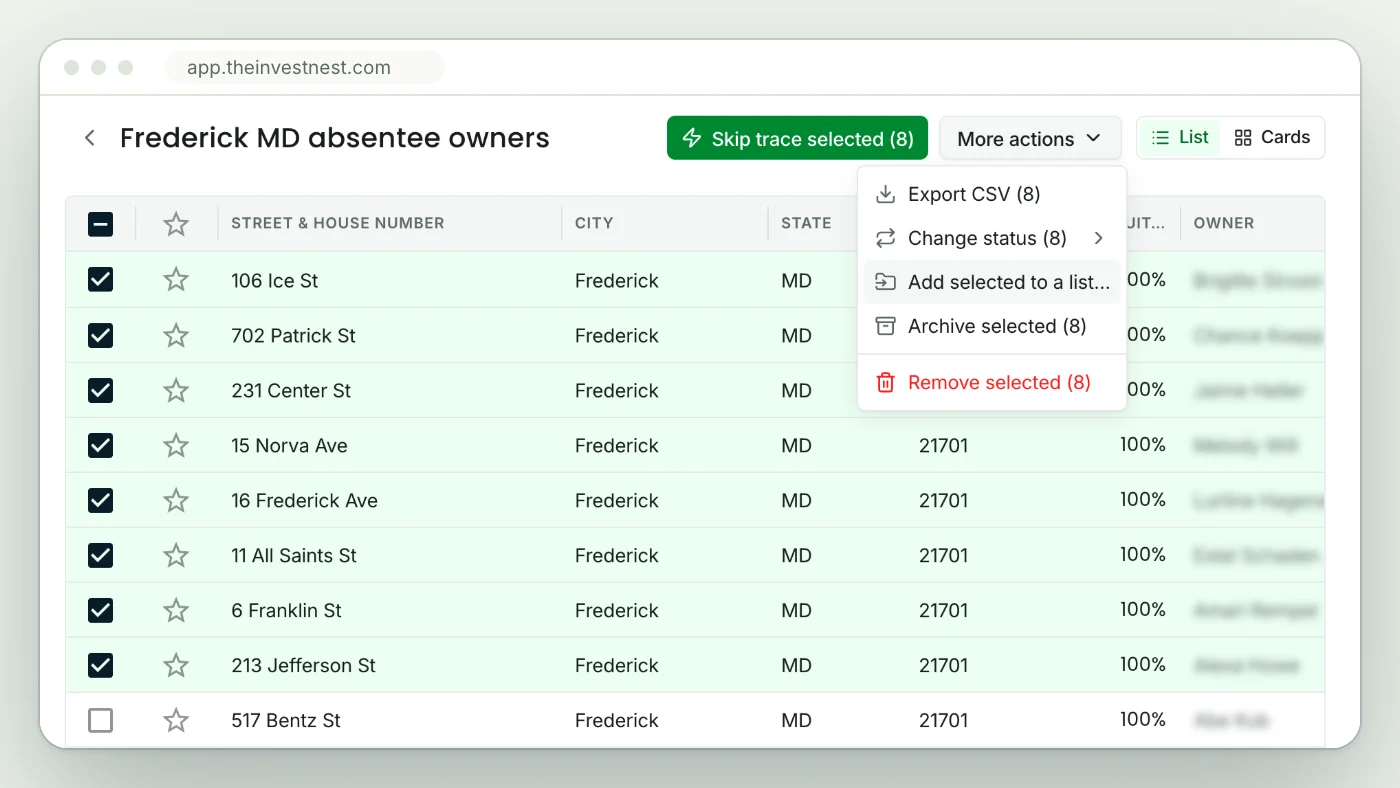
- Save the results to a list. Select the properties you want, or select all, and save them to a new list or to a list you already have.
- Stack your lists. List stacking means searching for owners who show more than one sign. Save a list for each kind of owner, then select the owners you want to call first and add them to one list. The out-of-state owner of a vacant house with unpaid property taxes shows three signs that they might sell.
- Upload the addresses you already have. If you drive for dollars or pull county records, upload your own list of property addresses as a CSV, XLS or XLSX file. We match each address to our records, and your list fills in with the owner, mortgage and equity details for every property.
How do you reach the owner of an off-market property?
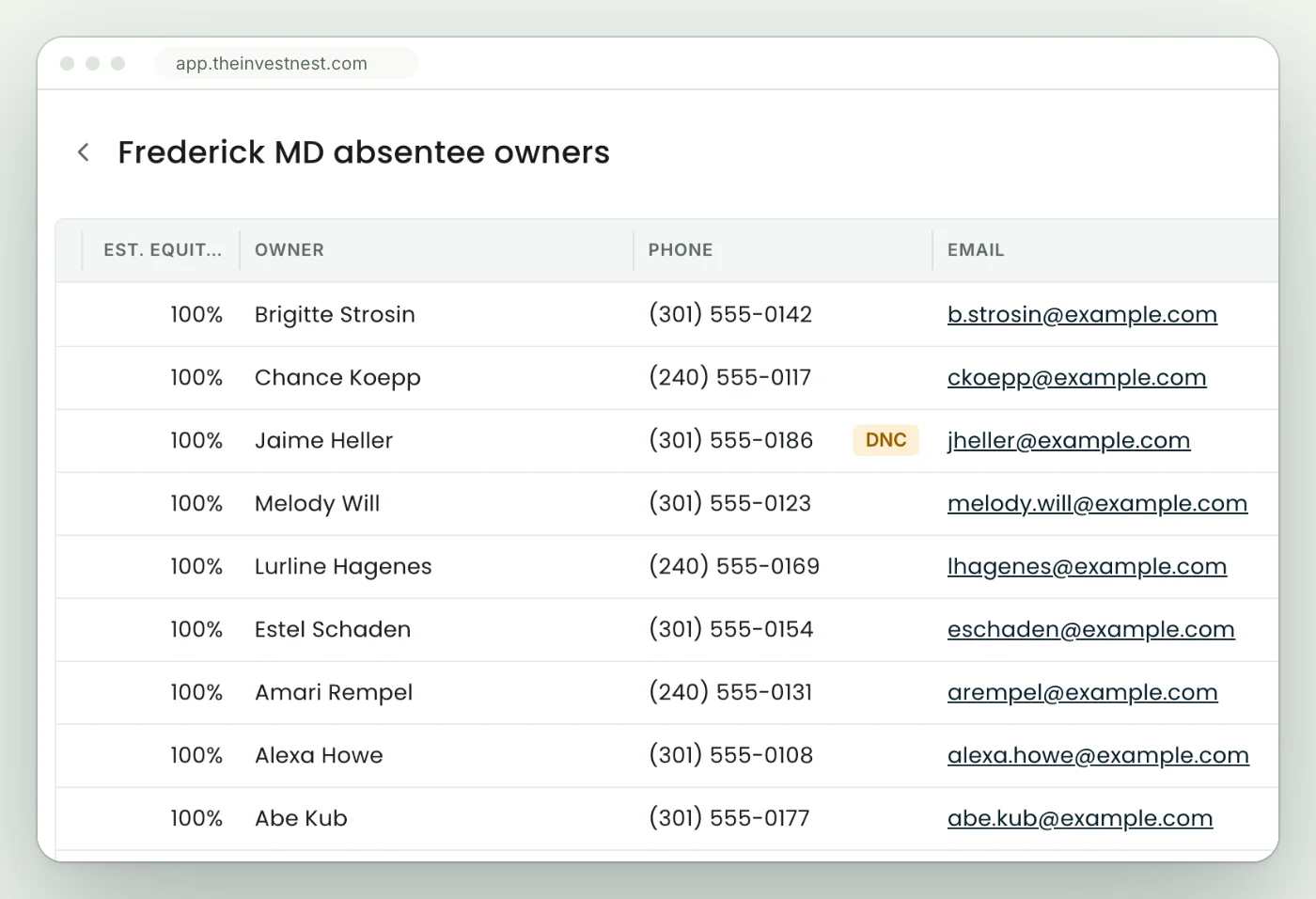
A list shows you the owners, but not how to reach them. A skip trace finds an owner's phone numbers, emails and mailing address from the property's address.
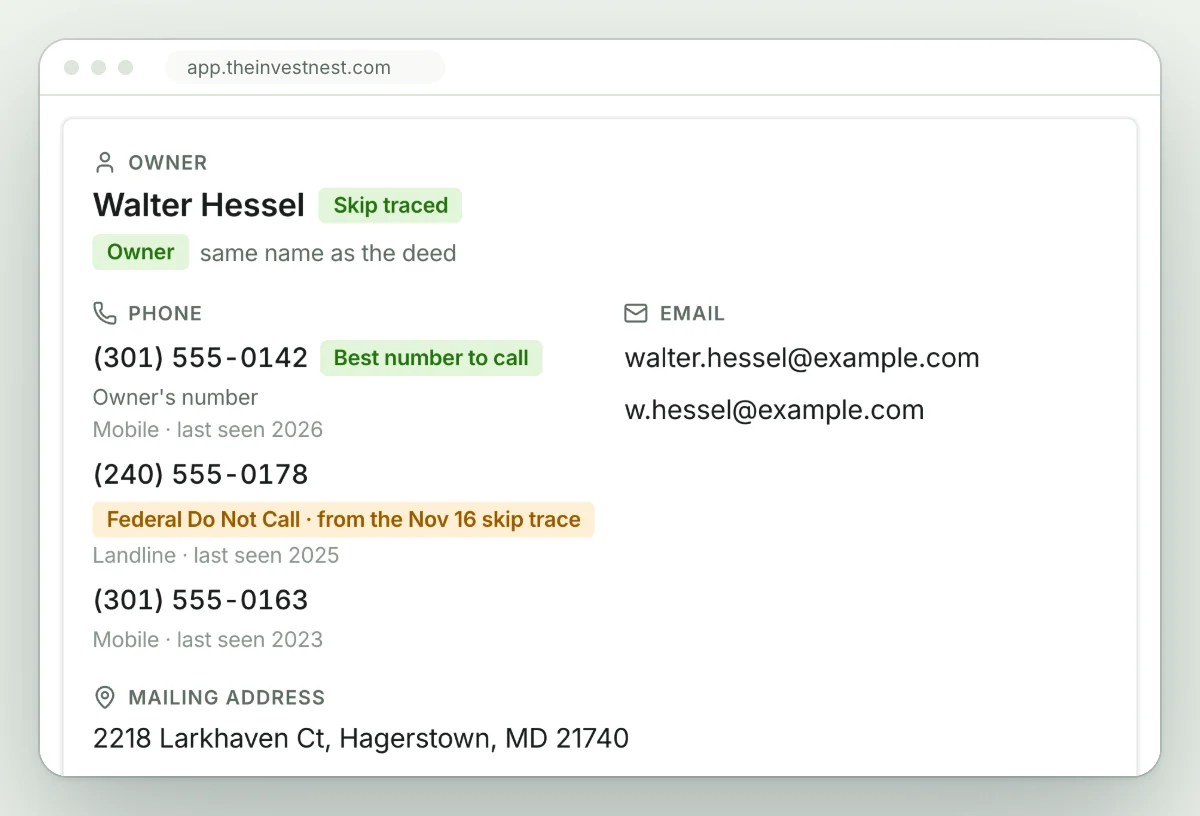
With The Invest Nest, open your list, select the owners you want or select all, and bulk skip trace them. Each owner's phone numbers, emails and mailing address show up in your list, plus any other properties they own. A skip trace can find more than one person tied to a property, such as a relative or a tenant, so when you open the property you'll see which person is most likely the owner, and which of their phone numbers is the best one to call. A phone number on the National Do Not Call Registry, the federal list of numbers whose owners have asked not to get sales calls, carries a do-not-call flag. Your plan includes 500 skip traces every month, and our skip tracing guide explains how skip tracing works.
Before you call or text an owner, check the National Do Not Call Registry and your state's rules on calling and texting people who haven't asked to hear from you. If an owner asks you to stop calling, stop calling that owner. This guide is general education, and it is not legal advice.
How do you make an offer on an off-market property?
Before you call, open the property and look at the owner, the estimated value and equity, the mortgage and any liens, which are debts recorded against the house, and the sale history.
When the owner answers, ask how they are doing and what they need before you talk about price. Our motivated sellers guide lists four questions to ask. The first call is for listening. Once you know what the owner needs and by when, work out your offer, for example with the 70% rule above, and call the owner back with it.
Most owners aren't ready to sell on the first call, so track every lead in your drag-and-drop deal pipeline in The Invest Nest, with a status and a note after every call, so you know who to call back and when.
When you and the owner agree on a price, the sale closes through a title company or a real estate attorney. In some states, such as Georgia, the Carolinas, Connecticut and Delaware, an attorney runs the closing.
An owner who has a mortgage at a low interest rate and little equity may fit a sub-to deal better. In a sub-to deal, short for subject-to the existing mortgage, the buyer takes over the seller's mortgage payments.
What does it cost to find off-market properties?
The Invest Nest has one plan, at $65 a month, and you can try The Invest Nest free for 7 days with 25 skip traces included in the trial. The plan includes a search of over 150 million properties, 21+ Nest Leads and over 100 additional filters, 500 skip traces every month, and a drag-and-drop deal pipeline. Extra skip traces you buy are 10 cents each and never expire. Our guide on how much skip tracing costs explains how skip tracing is priced. See pricing
Sources: Redfin, U.S. housing market data (October 2026); ICE Mortgage Monitor (November 2026, September data); Experian, how long a foreclosure stays on a credit report; Investopedia, How to flip houses (March 2026).